I put ELIZA in my Omarchy bar
We are right in the middle of it. Agents writing code, agents running workflows, models I talk to all day that would have read as science fiction a few years ago. And my desktop has caught up too. I run Omarchy, and with DHH leaning hard into agentic software, it’s starting to feel less like a Linux setup and more like an agentic OS: LLMs wired into the bar, the terminal, the whole way I work.
Sitting in all of that, I kept thinking about where it started. Not for the industry, for me. The earliest profound AI-like experience I ever had wasn’t a frontier model. It was ELIZA, the 1966 program that started it all.
So this one is an homage. To the matriarch!
A PalmPilot and Douglas Adams
In 1999 I ran out of a Douglas Adams talk to get something from my car.
He was in Sydney, speaking at the Australian Technology Park. Most of the room knew him as the author of The Hitchhiker’s Guide to the Galaxy, but he was just as much a technology visionary. Part of the way through he brought up ELIZA, the 1966 program that gives you the illusion of talking to a mind.
She was in my car. I had a Palm III then, and ELIZA lived on it.
When the talk ended and people lined up to meet him, I bolted out, grabbed that PalmPilot and came back to show him. This was the dawn of handheld computing, and he seemed to have no idea ELIZA had been ported to a handheld. Now the program he had just been talking about was sitting in his hand. He was amazed.
I knew the feeling. Before the Palm she was a DOS program on my PC. Before that, on an Apple Mac in the 80s, she was the first thing that ever felt like AI to me. I was a kid, and for the first few exchanges I was sure there was something intelligent in there.
These days I run Omarchy next to frontier and open-weight models that do things that kid would not have believed. ELIZA never understood a word anyone typed. She is still the matriarch of them all, and I am still amazed.
So I put her in Omarchy.
Two eras, two engines
Click the mark in the bar and ELIZA drops down over whatever you’re doing, with a toggle between two eras.
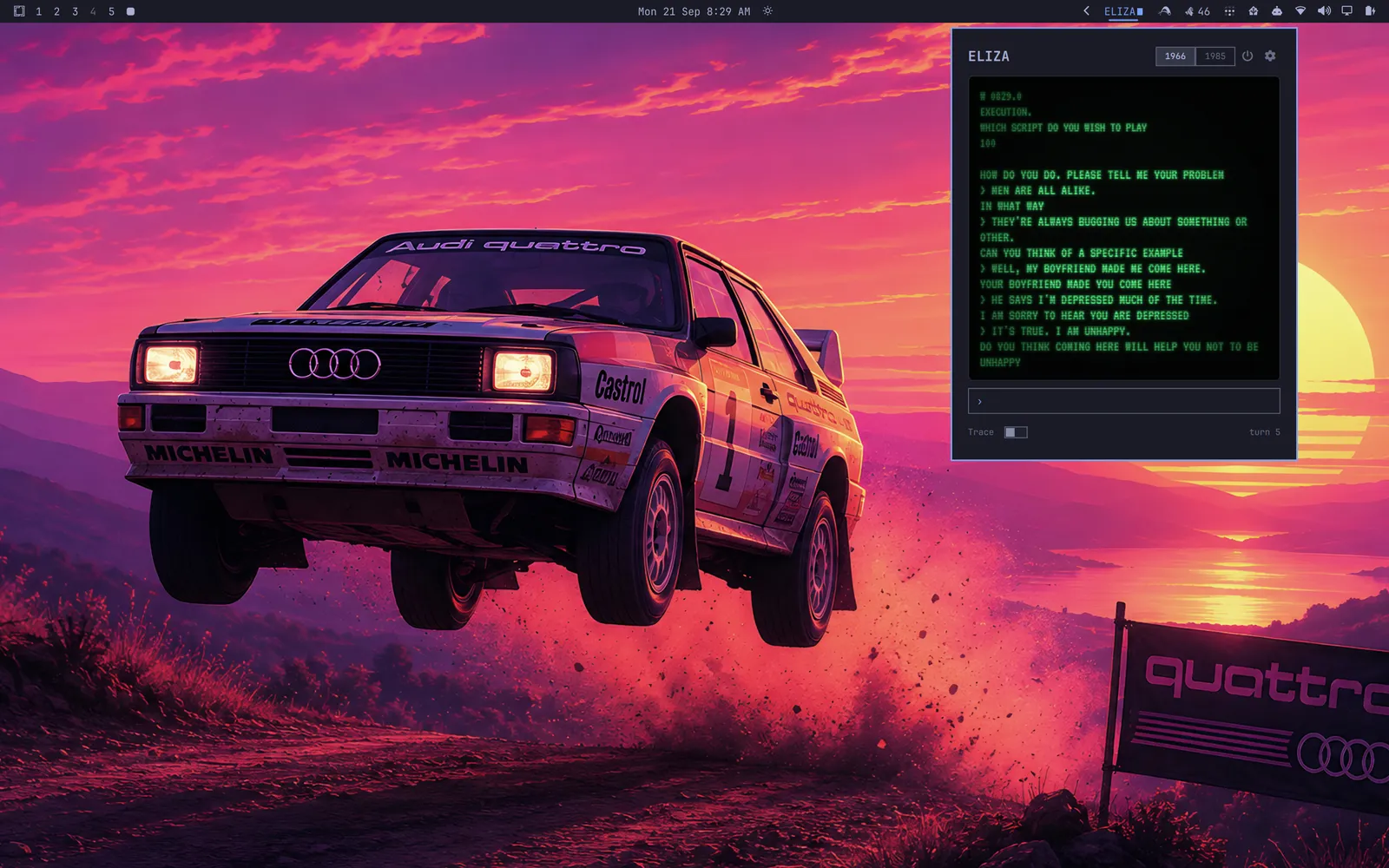
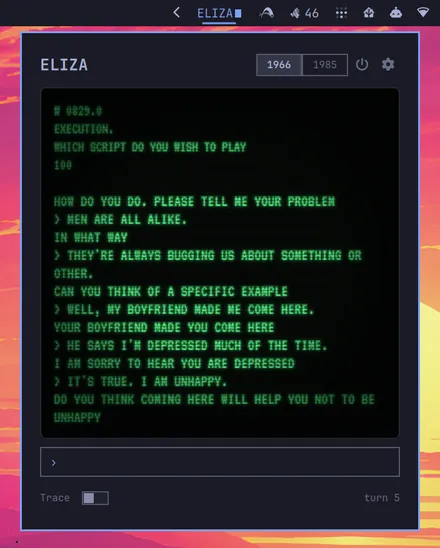
1966, CTSS teletype. Green phosphor, a CTSS-style login, and the DOCTOR script exactly as printed in the appendix of Weizenbaum’s January 1966 paper in Communications of the ACM. The engine is Anthony Hay’s JavaScript recreation of the original, which reproduces Weizenbaum’s program faithfully, bugs included.
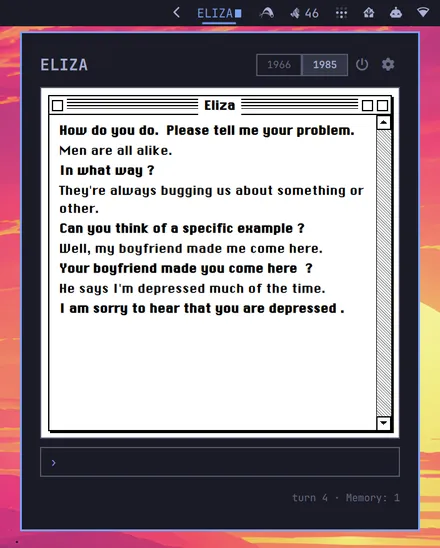
1985, Macintosh. This is the one I met as a kid. It’s a port of Charles Hayden’s Macintosh ELIZA engine, running the script from Eliza 1.3 for Macintosh, dated 1 August 1985, in a Chicago-font window.
Both eras replay the conversation printed in Weizenbaum’s 1966 paper. Only the patient’s lines are stored. ELIZA’s replies are produced live, each by its own era’s engine.
Install
omarchy plugin add https://github.com/vichong/omarchy-eliza
omarchy plugin enable io.github.vichong.eliza
Source, credits and licences are on GitHub. The plugin’s own code is MIT. The engines, scripts and fonts keep their own terms.
Credit where it’s due
None of this exists without Joseph Weizenbaum, whose estate released the original source under CC0 in 2021. Thanks also to Anthony and Max Hay for the JavaScript engine, Charles Hayden for the Macintosh version, and the ELIZA Archaeology Project for digging all of this back up.
The first chatbot belongs in the bar of an agentic OS. Say hello to her for me.